

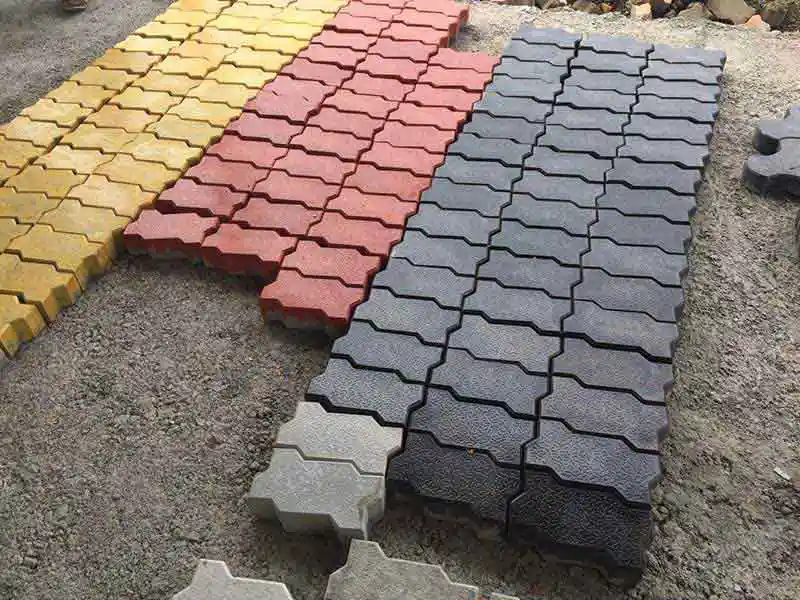
An Easy Approach for Road Construction
Interlocking Concrete Block Pavement (ICBP) has been
extensively used in a number of countries for quite sometime as a specialized
problem-solving technique for providing pavement in areas where conventional types of
construction are less durable due to many operational and environmental constraints.
ICBP technology has been introduced in India in construction, a decade ago, for specific
requirement viz. footpaths, parking areas etc. but now being adopted extensively in
different uses where the conventional construction of pavement using hot bituminous mix
or cement concrete technology is not feasible or desirable.
The paper dwells upon
material, construction and laying of concrete block pavement as a new approach in
construction of pavement using Interlocking Concrete Paver Blocks.
Introduction
Concrete paver blocks were first introduced in Holland in the fifties
as replacement of paver
bricks which had become scarce due to the post-war building construction boom. These blocks were
rectangular in shape and had more or less the same size as the bricks. During the past five
decades, the block shape has steadily evolved from non-interlocking to partially interlocking to
fully interlocking to multiply interlocking shapes. Consequently, the pavements in which
non-interlocking blocks are used are designated as Concrete Block Pavement (CBP) or
non-interlocking CBP, and those in which partially, fully or multiply interlocking blocks are
used are designated as ‘Interlocking Concrete Block Pavement (ICBP).
CBP/ICBP consists of a surface layer of small-element, solid un-reinforced pre-cast concrete
paver blocks laid on a thin, compacted bedding material which is constructed over a properly
profiled base course and is bounded by edge restraints/kerb stones. The block joints are filled
using suitable fine material. A properly designed and constructed CBP/ICBP gives excellent
performance when applied at locations where conventional systems have lower service life due to
a number of geological, traffic, environmental and operational constraints [1-8]. Many number of
such applications for light, medium, heavy and very heavy traffic conditions are currently in
practice around the world.
Advantages
There are many distinct features of ICBP as compared to the conventional methods of pavement construction and hence make it a suitable option for application in the specified areas [7 & 10]. Some of these are:
- Mass production under factory conditions ensures availability of blocks having consistent quality and high dimensional accuracy.
- Good quality of blocks ensures durability of pavements, when constructed to specifications.
- ICBP tolerates higher deflections without structural failure and will not be affected by thermal expansion or contraction.
- ICBP does not require curing, and so can be opened for traffic immediately after construction.
- Construction of ICBP is labor intensive and requires less sophisticated equipment.
- The system provides ready access to underground utilities without damage to pavement.
- Maintenance of ICBP is easy and simple and it is not affected by fuel and oil spillage.
- Use of coloured blocks facilitates permanent traffic markings.
- ICBP is resistant to punching loads and horizontal shear forces caused by maneuvering of heavy vehicles.
- Low maintenance cost and a high salvage value ensures low life cycle cost.
Limitations
However, important limitations of the technique are the following:
- Quality control of blocks at the factory premises is a prerequisite for durable “ICBP”.
- Any deviations of base course profile will be reflected on the “ICBP” surface. Hence extra care needs to be taken to fix the same.
- High quality and gradation of coarse bedding sand and joint filling material are essential for good performance.
- “ICBP” over unbound granular base course is susceptible to the adverse effects of poor drainage and will deteriorate faster.
- “ICBP” is not suited for high speed roads (speed above 60 km/h).